

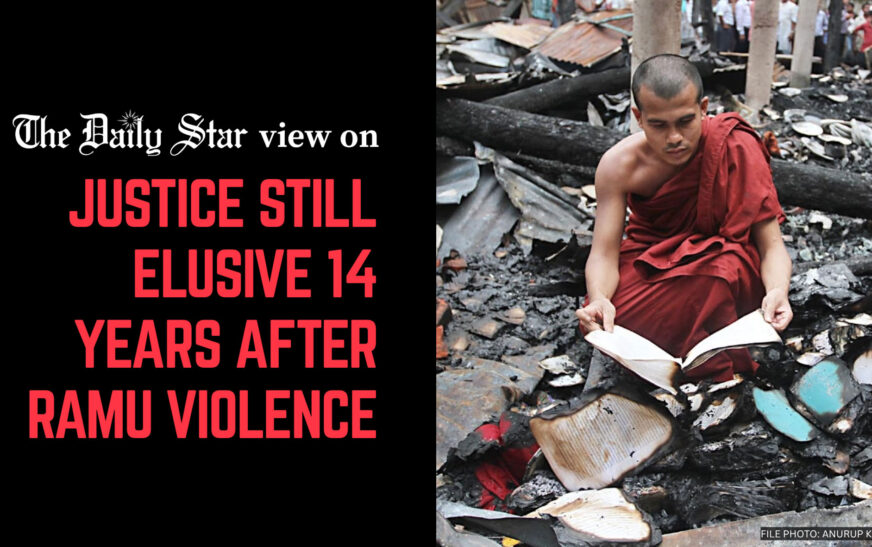
Fourteen years after the attacks on Buddhist communities in Ramu, not one person has been convicted, arrested or jailed. That sentence is the whole of the case for why this remains urgent.
Over the night of September 29 and 30, 2012, crowds moved through Ramu upazila in Cox’s Bazar, and then through Ukhiya and Teknaf. Twelve monasteries, some of them centuries old, were brought down. Thirty-four settlements sustained damage and 50 houses were looted or wrecked. Upwards of 300 Buddha figures were affected. Tripitaka manuscripts of considerable age were destroyed outright, and no verdict recovers those.
The trigger was a Facebook post said to be offensive to Islam. It was subsequently shown to be a photoshopped fabrication. The violence that followed was not spontaneous either: evidence indicates it was planned more than ten days in advance.
A judicial inquiry identified 298 people as responsible and documented failures by the local administration, intelligence agencies and law enforcement. The superintendent of police in Cox’s Bazar and the officer-in-charge in Ramu were both found negligent.
What followed in the courts has been attrition. Nineteen cases were filed. One has been settled and four were withdrawn during the interim administration. Fourteen remain without verdicts, and two writ petitions are still unresolved.
The cost of this is not confined to Ramu. Some Buddhist residents have left the country, which is the predictable consequence when a community watches an attack on its places of worship produce no legal result.
Fourteen years also degrades the cases themselves. Witnesses move, memories fade, and physical evidence deteriorates, so delay is not neutral; it is a quiet form of acquittal.
A judicial inquiry has already named those responsible, and the administrative failures are documented. What is absent is the decision to act on either. The state should set out, with dates, how the fourteen outstanding cases will be concluded, and why no one named in that inquiry has faced arrest.