

There is a particular kind of recognition that arrives late. You hear a song for years without it meaning much, and then one afternoon you look up at the people around a table and realise the song has been describing you the whole time.
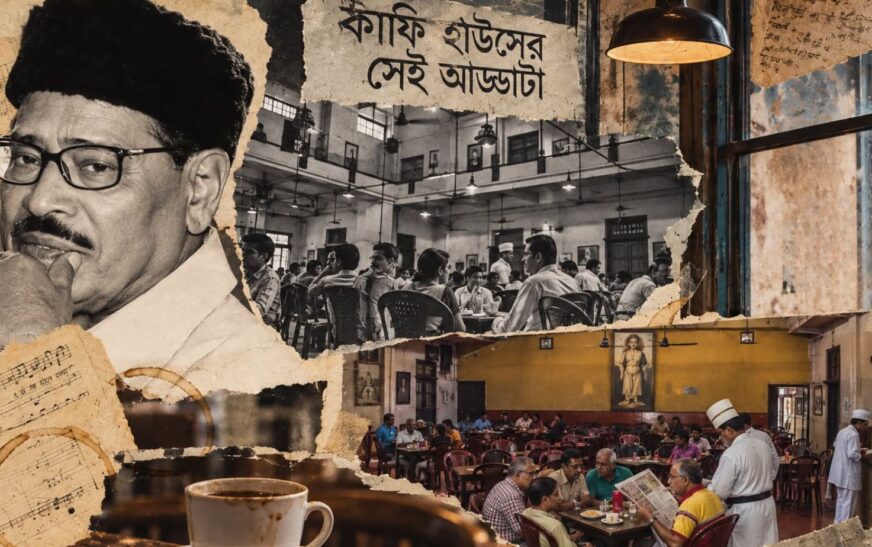
Manna Dey’s “Coffee Houseer Shei Addata” works that way. Its six figures are not characters so much as outcomes. Nikhilesh goes abroad. Moidul becomes his profession. Sujata marries. D’Souza plays. Roma Roy is remembered. Amal does not survive. Between them they cover most of what can happen to a group of friends given enough time.
I understood this in a cafe in Delhi, sitting with people I had grown up with and had not seen properly in years. The conversation moved easily enough. What struck me was how much of it was maintenance, filling in the gaps rather than continuing something. We had each become fluent in a life the others knew nothing about.
The song is unusually honest about how this happens. It does not blame anyone. Nobody drifts out of carelessness. They move because there is work elsewhere, or someone to marry, or a reason to leave, and the leaving is reasonable every time. The group dissolves through a series of sensible decisions.
What remains is the role of the narrator. Someone has to hold the account, and the song assigns that job to whoever is still sitting in the coffee house. It is a melancholy position but not a passive one. Remembering is the last shared activity available to people who no longer share anything else.
Amal’s absence is what gives the song its weight. Up to that point the losses are geographic and recoverable in principle. Then one of them is simply gone, and the others are left as people who knew him. Friendship acquires a custodial function it never had when everyone was present.
The song’s reach comes from how little it depends on its own period. The specifics are from another decade, but the structure repeats. Someone leaves, someone marries, someone is remembered, someone dies, and the rest sit with the account. Each generation supplies new names.
That is probably why it survives as more than nostalgia. Nostalgia asks you to want the past back. This song does something harder: it tells you the dispersal was always coming, that nobody is at fault, and that the table you are sitting at now is already becoming the one you will describe later.