

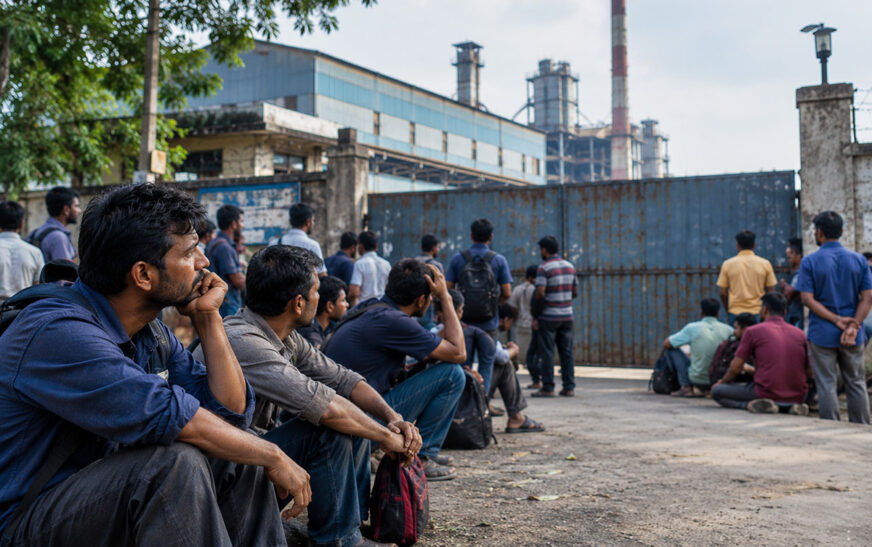
Two months after 11 factories closed on the south bank of the Karnaphuli, the wages that built a township have stopped. Landlords, shopkeepers and drivers are counting the cost.
Every morning at six, Rahima Begum unlocks the gate of her three-storey building in Shikalbaha and walks the corridors. Eleven of her 18 rooms are empty. Until July, each one housed a factory worker who paid Tk3,500 on the first of the month.
“I built this house on a bank loan because the factories were here,” said Begum, 54. “I have brought the rent down to Tk2,500 and still nobody comes. The loan instalment has not come down.” She remembers the area before the plants arrived. “This was paddy land,” she said. “S Alam’s factories built this place. Every building you see on this road went up because of them.”
Her empty rooms are one measure of what happened when 11 factories along the river shut at the end of July. A sugar refinery, two edible oil plants, a cement works, a packaging unit and six steel mills belonging to S Alam Group stopped together, and on 1 August about 6,000 workers and staff lost their jobs. The plants had been among the most important in the country’s food supply. At its peak, the group’s Karnaphuli sugar refinery met about a fifth of national demand for refined sugar, and its edible oil refineries brought in about a quarter of Bangladesh’s crude soybean oil imports.
With them went a wage bill of around Tk30 crore a month, close to Tk360 crore a year. Little of that money stayed behind the factory walls. It paid rent in the lanes around the plants, bought rice, oil and fish in the bazaars, kept auto-rickshaws busy at every shift change and travelled home to families in villages across the country. Over two decades, the unions along this stretch of the river grew around those wages.
At Charpara Bazaar, a short walk from the refinery gate, the change was immediate. Abdul Khaleque, who heads the market’s traders’ committee, estimates that daily sales across its 120 shops have fallen by about half since August.
“Factory people bought every single day: rice, oil, fish, phone recharge,” he said. “When thousands of people stop earning on the same day, the whole market feels it on the same day.”
Across the road from the steel mill gate, Jamal Uddin has run a tea stall for 12 years. At the morning shift change he used to pour 300 cups before nine o’clock. Now he sells about 60 in a day. In September he let his helper go, a young man from his home village.
“I could not pay him,” Uddin said. “There is nobody to serve.”
For two years before the closure, as raw materials ran short and production slowed almost to a halt, the company kept paying salaries and allowances, according to workers. For the workers themselves, the options now are narrow. Shahidul Islam, 38, ran a cold-rolling line at one of the steel mills for 14 years. The skill is specialised, and the country’s steel industry, already running at a third of its capacity, is shedding staff rather than hiring.
In September, Islam moved his wife and two children back to his village in Satkania to save on rent. He now travels between the village and Chattogram looking for work. “No other mill needs a cold-rolling operator,” he said. “My son’s school fees are due next month. I do not know where they will come from.” He received his final dues in August, he said, and that money is almost gone.
The closures reached beyond the payroll. The plants relied on transport operators to bring raw materials in from the port and take finished goods to dealers, and on contractors for maintenance, canteens and security. Mizanur Rahman owns eight trucks that once ran daily between the jetty, the factories and dealers across Chattogram.
“Half my trucks are parked,” he said. “The drivers sit at the stand all day waiting for a trip. When the factories were running, I never had enough trucks.”
Local government is feeling it too. Mohammad Yusuf, chairman of Charlakshya union parishad, said holding tax and trade licence collections are down this year and that several families have already left the union. “Almost every household here had someone in the factories, or rented to someone who did, or sold to them,” he said. “S Alam paid its people on time, every month, and that money stayed here. We need these plants working again.”
Economists say the effect of a closure of this size spreads well beyond the factory gate. “When a single employer accounts for most of the cash wages in an area, its closure is felt in rent, retail and transport within weeks,” said Dr Farhana Haque, an economist with UN. “The loss to the local economy is larger than the wage bill itself, because each taka of wages was spent several times over before it left the area.”
The company says the factories closed because they could not import raw materials after August 2024, and that most of the plants had been running far below capacity for two years before the final shutdown. The closures nonetheless sit awkwardly with the government’s own industrial agenda. At a May Day rally in Dhaka, Prime Minister Tarique Rahman said he had instructed the authorities “to assess how quickly each factory can be reopened to create employment opportunities.” In May, the central bank announced a stimulus package aimed at reviving more than 1,200 closed or partly closed industrial units. The group’s one plant still operating, the 1,320 MW SS Power coal-fired station at Banshkhali, continues to supply electricity to the national grid.
At the refinery, Nurul Amin, 52, spent 26 years on the production floor before the layoff notice. He still lives two lanes from the gate.
“The machines are still good,” he said. “Give us raw sugar and we can start them in a week. Even when there was nothing to refine, the company did not abandon us. We want to go back.”
Back in Shikalbaha, Rahima Begum has painted a new “to let” sign for her gate. “When the factories run again, these rooms will fill in a week,” she said. “Until then, I wait like everyone else.”