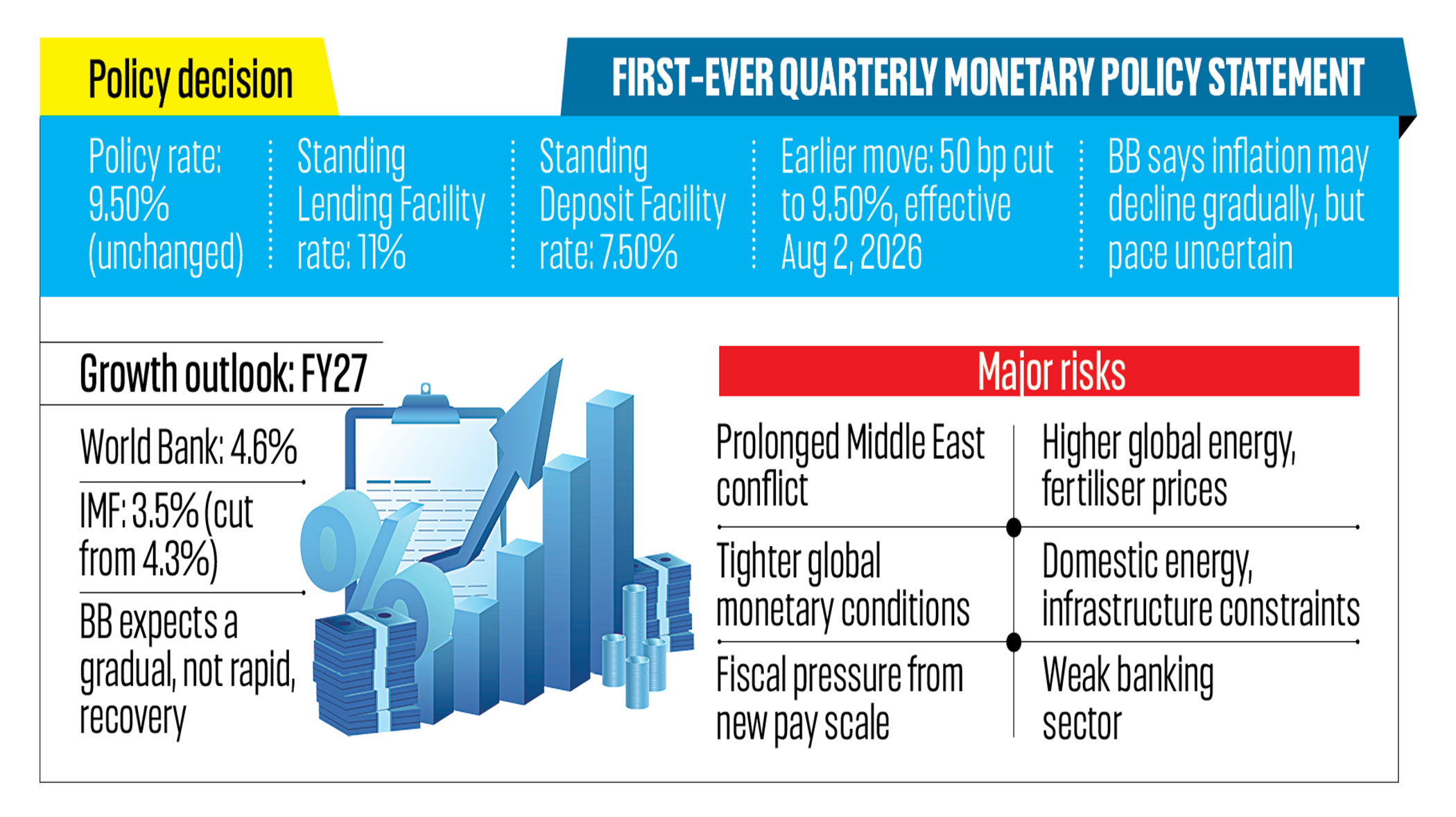



Bangladesh Bank’s move to quarterly monetary policy statements, replacing the half-yearly cycle, gives the central bank more frequent opportunities to adjust course. The first statement under the new schedule holds the repo rate at 9.5 percent, a choice that is defensible on the inflation numbers but leaves the harder question untouched.
The case for caution is straightforward. Headline inflation has come down to 8.26 percent, but non-food inflation is still running at 9.32 percent, and that component responds to policy more slowly. Cutting into it would risk giving up ground that took time to win.
The difficulty is that the transmission mechanism is not working as the framework assumes. Private sector credit grew only 4.75 percent in August even though banks are not short of liquidity. Money is available; it is not reaching borrowers.
The reason is visible in the asset quality numbers. Non-performing loans stand at 32.78 percent across the banking sector, which holds roughly 90 percent of financial system assets. A banking system carrying that much bad debt cannot allocate credit efficiently whatever the policy rate, because capital is tied up against existing losses and risk appetite collapses.
That shifts the centre of the problem. Weak governance, regulatory capture and related-party lending are not side issues to be addressed after stabilisation; they are the reason monetary policy is producing so little effect. Until the credit allocation machinery is repaired, rate decisions are adjustments to a price that is no longer clearing the market.
Monetary policy also cannot carry this alone. Fiscal restraint on government borrowing from banks, genuine exchange rate flexibility and supply-side measures on the goods driving non-food inflation all need to move in the same direction. Without them, the central bank is left using one instrument against several constraints.
A quarterly cycle is a useful change. But a more frequent review of the same narrow instrument will not substitute for banking reform, and treating rate setting as the main lever risks mistaking visible activity for progress.